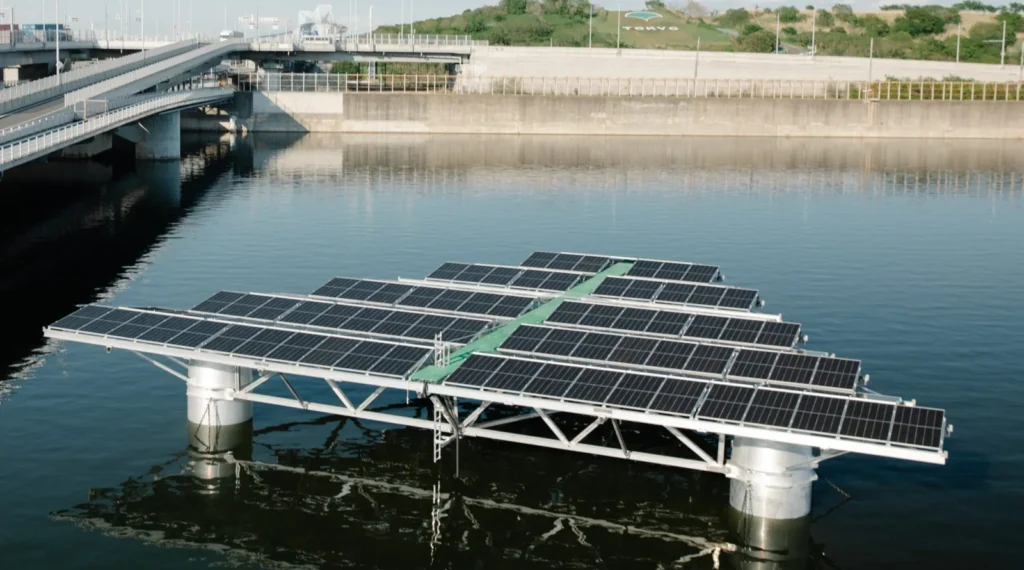
Tokyu Land Corporation, SolarDuck and Kyocera Communication Systems Corporation have completed the installation of Japan’s first offshore floating solar photovoltaic (OFPV) power plant on the sea surface.
Throughout 2024, SolarDuck and Everblue Technologies will demonstrate power generation using OFPV power generation facilities, storage of electricity in batteries on the ground, and transportation of the storage batteries.
SolarDuck and Everblue Technologies were selected for the demonstration in November 2022. The renewable energy generated will be used to power Open Street Corporation’s electric mobility vehicles and an electric boat. There are also plans to use renewable energy for future events in the Takeshiba area of the Tokyo Bay. In addition to aiming for the practical application of Japan’s first OFPV power plant, the demonstration test of local production for local consumption of energy centered on the Tokyo Bay area is expected to contribute to the study of urban models that can be deployed in other parts of Japan and abroad.
Tokyo Bay eSG Project
This is a demonstration project by the Tokyo Metropolitan Government that aims to realize the world’s most advanced energy generation and transmission from the Tokyo Bay area. It forms part of the Tokyo Bay eSG Project, which is an initiative of the Tokyo Metropolitan Government’s Policy Planning Bureau. The details of this project will be finalized upon consultation with the Tokyo Metropolitan Government.
Offshore solar power generation facilities
During the demonstration, renewable energy generated by the offshore solar power generation facility (approximately 30 x 26 x 6m) installed in the central breakwater area will be stored in storage batteries on land. The energy will be transferred to mobile batteries as needed to power events and electric mobility vehicles in Takeshiba and other bay areas.
According to the partners, the demonstration experiment was designed because Tokyo, a major energy consumption area, is dependent on power transmission from the suburbs. If the generation and consumption of renewable energy in the Bay Area can be achieved, they can reportedly expect the realization of an urban model based on local production for local consumption that is unique to the Tokyo Bay Area, as well as its future expansion to other parts of Japan and abroad.